
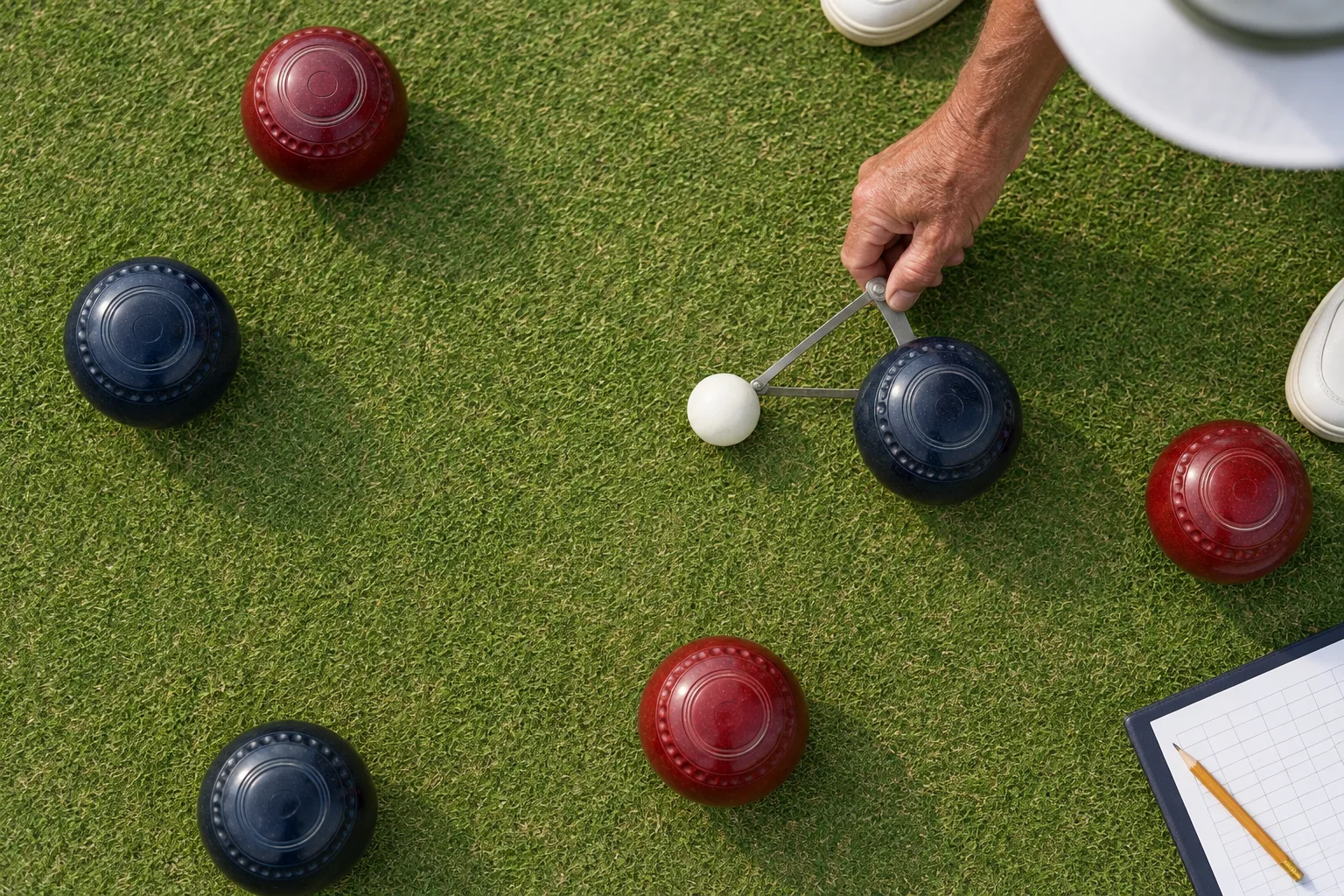
The basic lawn bowls rules fit into one sentence: finish closer to the jack than your opponent. Scoring stays simple even when the head looks crowded.
This guide covers the rules a new player encounters most often. Formal competitions also use domestic regulations and event-specific conditions of play, so consult the current Laws of the Sport and your controlling body when a precise ruling matters.
The aim of lawn bowls
Players deliver biased bowls from a mat towards the jack. The bowl curves as it loses speed. After every bowl has been delivered, the player or team with the bowl nearest the jack wins the end.
How to score an end
The winning side scores one shot for each of its bowls that lies closer to the jack than the opponent’s nearest bowl. The other side scores zero for that end.
Your bowl is first and your opponent is second: you score one.
Your bowls are first, second and third: you score three.
Your first two bowls are closest but the opponent has third: you score two.
Agree the result before moving the jack or any bowl. When the order is unclear, measure rather than guess.
The mat and the jack
The mat marks where deliveries begin. In formal play, the player who delivers the jack follows rules for mat placement, jack length and centring. Social sessions may simplify the setup for beginners, but keeping part of one foot on or above the mat at release remains a useful habit from the start.
Live bowls, dead bowls and touchers
What is a toucher?
A bowl that touches the jack during its original course is a toucher. It is normally marked with chalk. A toucher can remain live if it later comes to rest in the ditch within the rink boundaries.
When is a bowl dead?
A non-toucher that finishes in the ditch is usually dead. A bowl that comes to rest outside the rink boundaries is also dead. The exact law matters when a bowl or jack has been displaced, so avoid moving anything until the position is agreed.
What if the jack moves?
The jack is live and may be moved by a bowl. If it stays within the rink or finishes in the ditch within the rink boundaries, play can continue around its new position. If it leaves the rink, the end may be declared dead or handled under the applicable conditions of play.
Common beginner questions
Who bowls first on the next end?
The winner of the previous end normally starts the next one.
Can a bowl curve outside the rink?
Its path may travel outside a boundary, but it must finish in a valid position to remain live.
Can I move a bowl to measure?
No. Secure any leaning bowl if necessary and measure without disturbing the head.
A fair routine for close calls
Look from directly above the jack and likely shot bowls.
Ask both sides to agree if the result is clear.
If it is not clear, use the right measuring tool.
Measure the shortest distance consistently.
Record the score before clearing the head.
Good rules knowledge does not make play fussy; it removes uncertainty. Calm agreement and careful measurement keep the result trusted.