
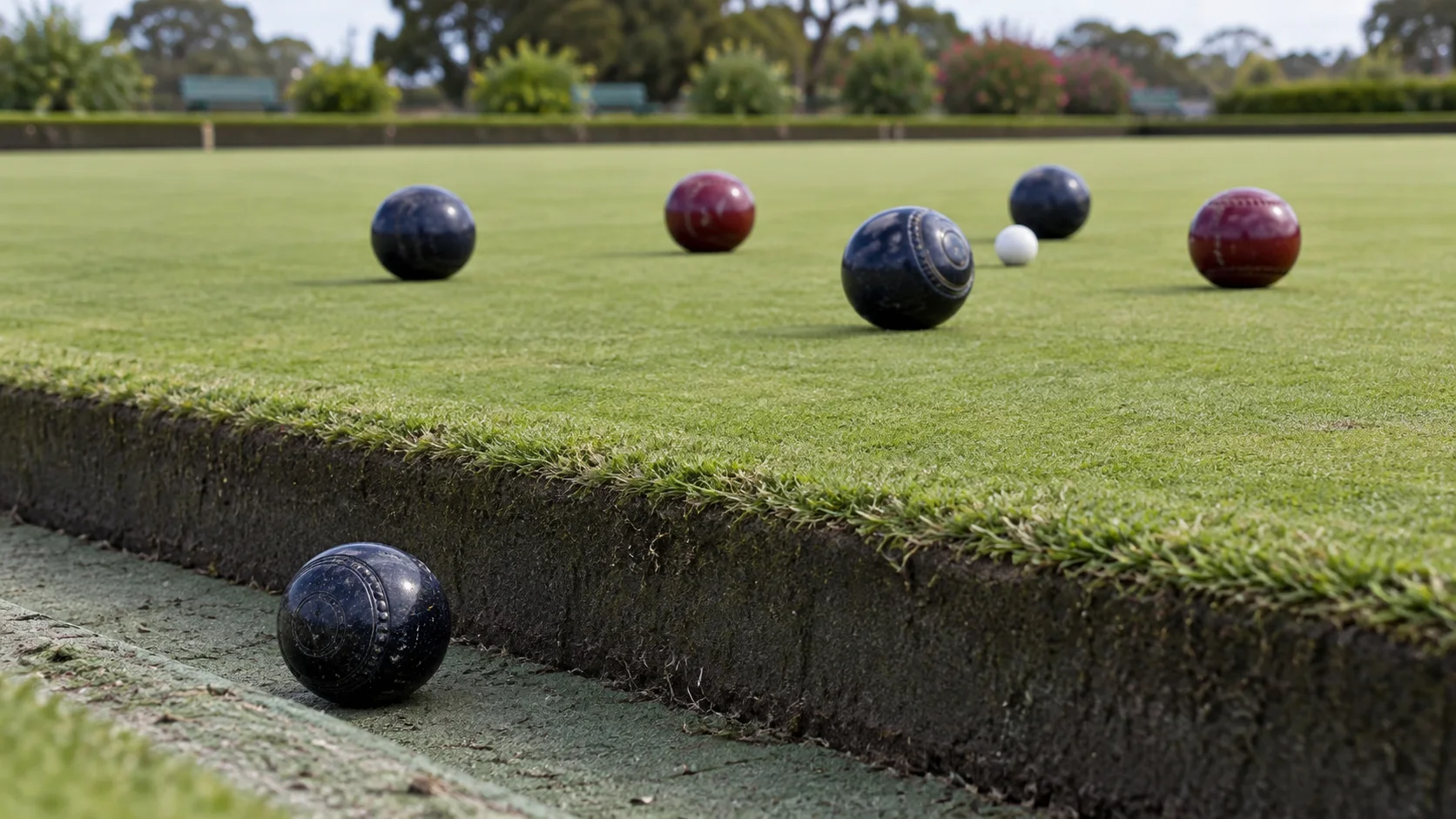
A bowl in the ditch is not automatically dead. The deciding question is often whether it touched the jack during its original course. That distinction—and a few boundary and distance rules—explains most dead-bowl situations.
When is a bowl dead?
Under the World Bowls laws, a bowl is dead when any of these applies:
it is a non-toucher and comes to rest in the ditch;
it is a non-toucher that rebounds onto the rink after contacting the bank face, or the jack or a toucher in the ditch;
after its original course or later movement, it rests less than 14 metres from the centre of the mat line;
after being moved in play, it passes completely outside the rink boundaries;
in its original course, it crosses a side boundary on a bias that cannot bring it back; or
it finishes outside a side boundary, even if touching the outside edge of a line jack.
When is a bowl still live?
A toucher is a bowl that contacts the jack during its original course. It remains live if it rests in the ditch within the rink boundaries. Mark it with chalk as soon as it stops, or nominate it if touching the bowl could alter the head.
A bowl can also remain live if it travels outside a side boundary during its original course but curves back and comes to rest within the rink. A toucher that rebounds from the bank face back onto the rink is live too.
Who decides?
The skips—or the opponents in singles—decide as soon as they recognise that a ruling is needed. If they cannot agree, the umpire decides. Once declared dead, the bowl should be removed from the rink promptly.
Dead bowl versus dead jack
A dead bowl is removed while the end continues. A dead jack normally makes the end dead, although a competition may use a pre-declared re-spot rule instead. A dead end is not counted and is normally replayed.
Do not let technology make the rules decision
A camera can provide a useful view of where bowls and jack lie, but it cannot decide whether a bowl touched the jack earlier, crossed the boundary on an unrecoverable bias or satisfied every condition of a law. Observation, player agreement and the umpire remain essential.
WGTS is most useful after live bowls have settled: it can help compare the head and keep the scorecard moving. Treat it as decision support, never as permission to remove a bowl.
Take a clearer view onto the green
WGTS brings camera-assisted bowl measurement and digital scorecards to your phone. Use it as a decision-support tool for social play and practice; for competition decisions, follow your club and event rules and call the umpire or use an official measure whenever required.
Download WGTS for iPhone or get WGTS on Google Play.
Rules note: this guide is based on the World Bowls Laws of the Sport, Crystal Mark Fourth Edition. Domestic regulations and a competition’s Conditions of Play can add to or vary some procedures. Check the rules for your event.